NOESIS — Cognitive Engine for Physical AI
NOESIS
COGNITIVE AND SENSORY INTELLIGENCE

Cognitive Engine for Physical AI

{{ heroMark }}
Member of the NVIDIA Inception Program
01 Transformer-less
02 Weight Free
03 Continual Learning
04 One-Shot Learning
Today's AI → Noesis {{ shLabel }} / 04

Transformers that need a data centre.

Runs at the edge.

Transformer-less. No GPU required. It runs even on a laptop.

Billions of parameters, frozen into weights.

Weight free.

One million objects remembered in 50MB.

Retrained when the world changes.

Keeps learning.

Noesis adapts through experience while it operates.

Trained on millions of examples.

Learns from one.

15 seconds to learn a new object from a single short clip.

Transformer-less
Weight Free
Continual Learning
One-Shot Learning
01MEET NOESIS
01

What is Noesis?

Noesis is a cognitive engine that gives autonomous systems the ability to perceive, learn, remember and make decisions, bringing human-like cognitive capabilities to Physical AI.

02

What makes it different?

Noesis learns from minimal examples, retains knowledge through persistent memory, and continuously adapts through experience, without relying on resource-intensive computing or conventional AI architectures.

03

Why does it matter?

By making intelligence more computationally efficient, Noesis enables capable, adaptive and autonomous systems to operate at the edge and scale across real-world applications.

02APPLICATIONS
WHERE NOESIS WORKS
{{ c.num }} {{ c.title }}
03PERFORMANCE
Learning time 15s to learn a new object from a single short clip, then identify it frame by frame.
Memory 50MB to store one million objects, down from 20GB. Runs even on a laptop without a GPU.
False alarms0 false alarms in our measured tests. Noesis does not hallucinates.
{{ journalIndex }}Journal
Benchmarks, research findings and our journey.

Journal

Benchmarks, research findings and our journey.

Noesis joins the NVIDIA Inception program

We are proud to share that Noesis has been accepted into the NVIDIA Inception program.

Thank you to the NVIDIA Inception team for believing in what we are building. For a small team in Singapore working on a new approach to Physical AI, this recognition means a great deal.

NVIDIA Inception Program badge

This year we went from a first-principles idea to an MVP that learns objects in seconds, says “I don’t know” when it should, and holds a million objects in 50MB. Each step has been a reminder that robots can learn differently.

Being part of Inception motivates us to keep pushing the limits of what Physical AI can do.

There is a lot ahead: our robotic arm, our first trials with partners, and the next 10 million objects. Exciting updates on our benchmarks are coming soon, and we will keep sharing the journey here.

Previous · August 2026 From 20GB to 50MB: compressing Noesis’ memory → Next · October 2026 Noesis in simulation: 100% task success →

Noesis in simulation: 99% task success

This month we put the Noesis Cognitive Engine to the test, benchmarking it across multiple virtual simulation environments.

Across in-house runs on Robodojo, Astra and robosuite test cases, spanning block stacking, door opening and object placement, Noesis completed every single task. That is a ~99.9% success rate on every suite.

Simulation suiteTask success
Robodojo99.9%
Astra99.9%
robosuite99.9%
Fig. 01 · In-house simulation runs, October 2026.

01Understands a new task in under a minute

Noesis was given the task instruction and nothing else. In under a minute, it understood the task, identified the objective and planned the sequence of actions to achieve it, then executed entirely on its own.

02Self-corrects when the world moves

We ran block stacking from both a standard initial position and a randomized initial position for every block. When the blocks moved, Noesis re-localized them, corrected its plan autonomously and completed the stack.

038+ hours, 14,000+ cycles, near-zero failures

Then we let it run. Over 8+ hours of continuous operation and more than 14,000 cycles across both conditions, task success held at ~99.9%. All from just task instructions.

Clip 01Continuous block stacking, standard initial position

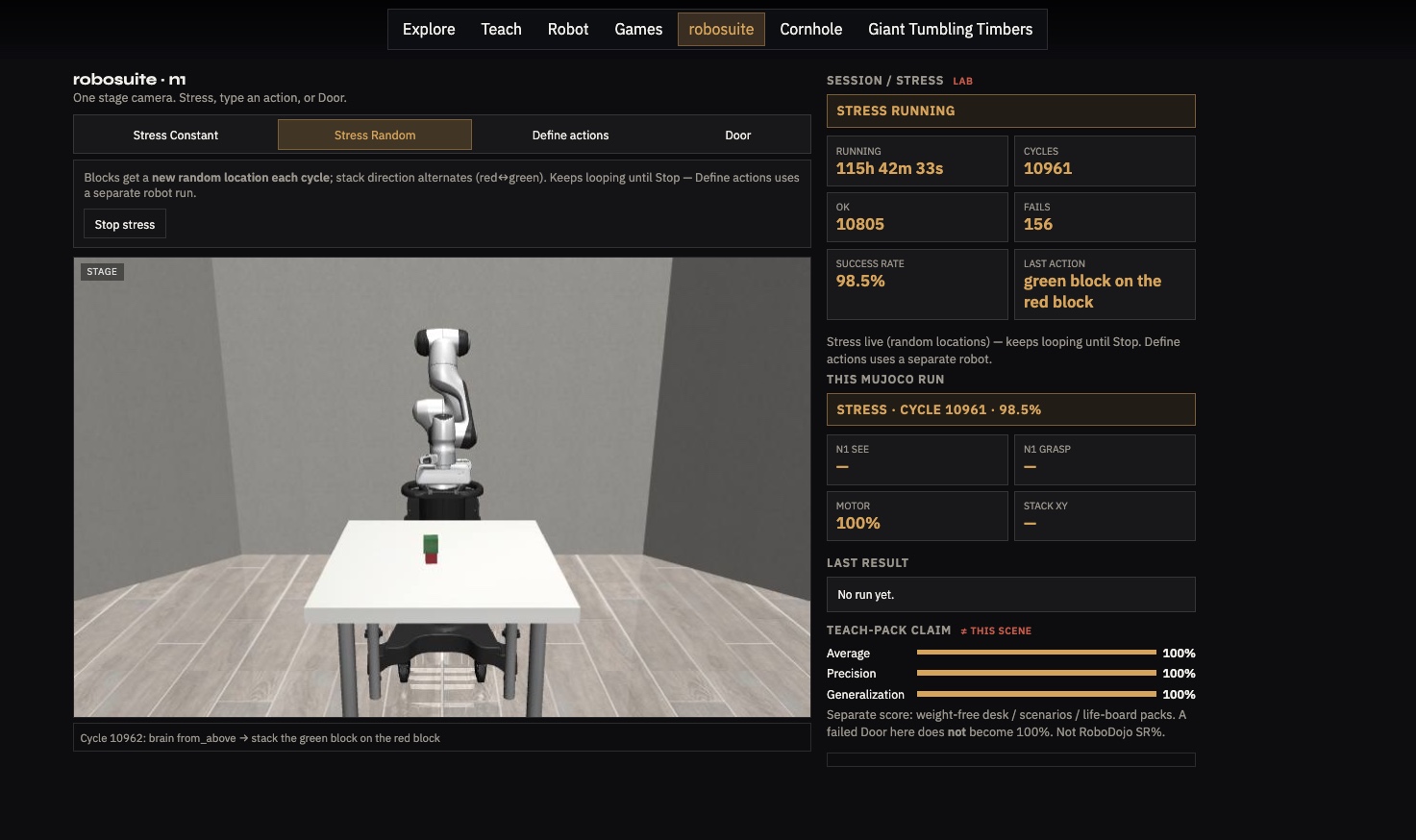
With block locations randomized every cycle, we pushed further: over 115 hours of continuous operation and nearly 11,000 cycles, the success rate dipped only to 98.5%.

robosuite stress test with random block locations: 115h 42m running, 10,961 cycles, 98.5% success rate
Fig. 02robosuite stress run, random block locations: 10,805 of 10,961 cycles successful

robosuite is a simulation framework powered by the MuJoCo physics engine for robot learning. It also offers a suite of benchmark environments for reproducible research.[1]

References

[1]Yuke Zhu, Josiah Wong, Ajay Mandlekar, Roberto Martín-Martín, Abhishek Joshi, Kevin Lin, Soroush Nasiriany and Yifeng Zhu. “robosuite: A Modular Simulation Framework and Benchmark for Robot Learning.” arXiv preprint arXiv:2009.12293, 2020. arxiv.org/abs/2009.12293

Previous · October 2026 Noesis joins the NVIDIA Inception program → Next · November 2026 What is a transformer-less AI? Like a child learning →

From 20GB to 50MB: compressing Noesis’ memory

Memory is at the core of Noesis. Every object it learns is stored so it can be recognised again later, and for a robot that keeps learning, that memory keeps growing.

Earlier this month, storing one million objects in Noesis took about 20GB. Now, we brought the same one million objects down to 50MB, a reduction of roughly 400×.

20GBBefore
50MBNow
~400×Smaller
40BPer object

Each object now takes 40 bytes. The remaining 10MB or so is shared overhead: the index and codebook that let Noesis look objects up quickly.

A million objects. 50MB. No GPU. Tested on a MacBook M1 Pro — no GPU, no cluster, no cloud dependency.
Storage per 1M objects
255075100 GB
Lower is better
NOESIS bit-packed (D=32768)40 bytes / object
50 MB
ResNet-50 embedding (float32)8.19 KB / vector · 49 KB / object
49 GB
VGG-16 FC7 (float32)16.38 KB / vector · 98 KB / object
98 GB
3D CNN (video clips)~82 KB / clip
82 GB+
Fig. 01 · Storage for 1M objects. Embedding baselines assume 6 views per object. The Noesis total includes about 10 MB of index and codebook overhead.

For comparison, a common approach in computer vision stores each object as a set of embeddings from a pretrained network. With a ResNet-50 embedding (2,048 float32 values, 8.19KB per vector) and six views per object, one million objects need about 49GB. With VGG-16’s FC7 layer (4,096 values, 16.38KB per vector), that rises to about 98GB.

At 50MB, Noesis stores one million objects in roughly 1,000× to 2,000× less space than these standard embeddings.

Compression only matters if the memory still works. On our in-house object recall test, Noesis retained 0.95–0.97 accuracy with <5% of its memory corrupted.

What this means for the system

At 50MB, a million-object memory fits comfortably in RAM on a single laptop. We ran this on a MacBook M1 Pro with no GPU, no cluster and no cloud dependency. Noesis does not need to page memory from disk or call out to a remote database to recognise what it sees.

Less memory to move means less compute spent moving it. Lookups stay local and light, which matters for robots that run on battery and on compact onboard computers rather than data-centre hardware.

What this means for users

For teams deploying robots, a smaller memory lowers cost at every level. There is no need for GPUs or a cloud vector database to store what the robot has learnt, and existing hardware can hold far more knowledge.

It also makes memory easier to share. A 50MB memory can be copied, backed up or synced across a fleet in seconds, so one robot’s learning can reach others quickly.

We will keep pushing this further, and we can’t wait to scale it up to the next 10 million objects.

Previous · August 2026 Our MVP learns objects, and says “I don’t know” → Next · October 2026 Noesis joins the NVIDIA Inception Program →

Our MVP learns objects, and says “I don’t know”

This month, our MVP reached a milestone we have been working towards: it can learn new objects and identify them afterwards.

Just as importantly, it says “I don’t know” when an object is unclear or has not been learnt. Instead of forcing a guess, Noesis abstains.

Clip 01Learning a bottle from a 15-second clip
Clip 02Identifying the bottle frame by frame, immediately after

We have developed this in simulation. In Clip 01, Noesis is shown a bottle for 15 seconds and learns it from that short clip alone. Clip 02 runs immediately afterwards: Noesis identifies the bottle frame by frame, with no further training in between.

We tested a total of 5 objects, and Noesis identified each item correctly.

Alongside the technical work, we have been reaching out to robotics companies for collaborations, and the response so far has been positive. Over the past month, 5 robotics companies have entered early-stage discussions with us about collaboration and trial deployments. We can’t wait to share more on those conversations and what we learn from them.

2Regions · SG, EU

We are excited to bring our cognitive engine to different robots and show what it can do through test deployments. If you are a robotics or humanoid company, reach out to us. We are ready to set up a sandboxed trial of Noesis on your system.

Previous · July 2026 Noesis – The robotics intelligence stack → Next · August 2026 From 20GB to 50MB: compressing Noesis’ memory →

Noesis – The robotics intelligence stack

When we came into the Robotics world, one of the things that hit us was how much we expect the AI-LLMs world to stay the same.

Once a model is trained and deployed, and when a new object is introduced the environment changes—and suddenly we need more data, more training, more compute.

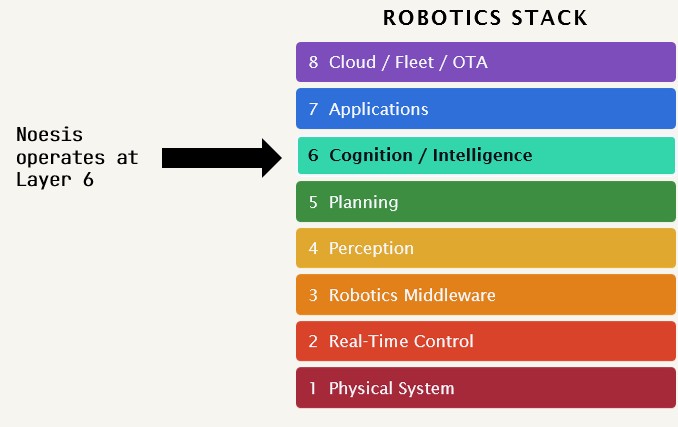
Robotics stack diagram — Noesis deploys at Congition/Intelligenc, Cognition / Intelligence, within an 8-layer stack from Physical System up to Cloud / Fleet / OTA.
Fig. 01

Our goal is to build an intelligence stack for robotics and Physical AI that can learn, remember, and adapt while it is operating. And this month, we have started seeing some results that make us genuinely excited. One of the simplest experiments is also one of our favorites.

We put a new object in front of the system and show it for around 45 seconds. No lengthy training pipeline. No GPU. After that, the object is immediately recognizable. More importantly, Noesis can also say "I don't know." If something doesn't match what it has learned, the system can abstain instead of guessing or hallucinate a closest match.

In our measured tests so far, we recorded 0 false alarms.

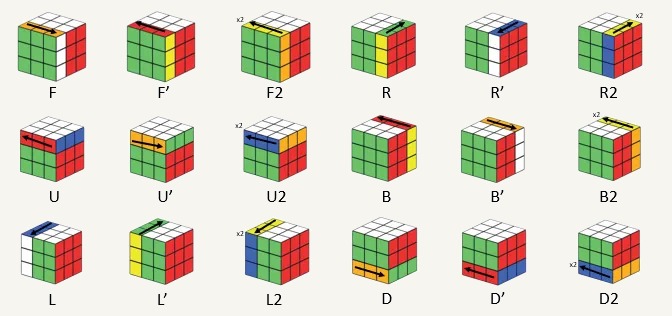
For a robot operating in the physical world, we believe the ability to acknowledge uncertainty is just as important as recognition itself. We've also been pushing beyond simple object recognition. Our virtual arm solved 200 unique Rubik's Cube scrambles, while retaining the abilities it had already learned. That's important to us because continual learning isn't very useful if every new skill comes at the cost of something the robot already knows.

Rubik's Cube move notation chart, showing all 18 face turns: F, F', F2, R, R', R2, U, U', U2, B, B', B2, L, L', L2, D, D', D2.
Fig. 02

We also gave Noesis six real-shaped objects to learn. With just one demonstration per object, it could distinguish objects such as a mug and a lamp based on their shape alone. Then we started making things harder: 10 colours across 5 shape families, with randomized sizes. The idea was to see whether the system could learn concepts rather than simply memorize one particular object at one particular size.

These experiments are still early. But they are helping us validate our thinking that robots shouldn't need to be completely retrained every time the world changes. They should be able to learn something new, remember it, build on what they already know—and, just as importantly, recognize when they don't have enough information to act.

Previous · June 2026 Why is Noesis different → Next · August 2026 Our MVP learns objects, and says “I don’t know” →

What is a transformer-less AI? Like a child learning

Almost every AI system in the news today, from chatbots to the latest robot foundation models, is built on the same architecture: the Transformer. When we describe Noesis as transformer-less, people often ask what we mean.

What a Transformer does

The Transformer was introduced in 2017[1]. It reads a sequence of tokens and uses a mechanism called attention to work out how each token relates to every other. During training it adjusts billions of numerical weights until it can reliably predict what comes next. Everything the model knows ends up stored in those weights.

That design works extremely well for language. For a robot, we see four consequences:

  • —Learning happens before deployment. Teaching the model something new means retraining or fine-tuning it, usually offline on GPUs.
  • —New learning can overwrite old learning. Updating shared weights for one task can degrade others, a problem known as catastrophic forgetting.
  • —Compute grows quickly. Attention cost rises with the square of the input length, and large models need substantial memory and power to run.
  • —Simulation doesn’t fully transfer. A model trained in simulation still needs fine-tuning once it is deployed in the real world, and a change in camera position or hardware means retraining again.

What Noesis does instead

Imagine how a child learns. The child watches someone do something and listens as the action is described. Noesis learns the same way: it combines what it sees with audio or text to create a memory.

Noesis is designed for human-like cognition and sensory perception. Humans are born with senses for touch, pressure, temperature, direction and spatial awareness, and draw on all of them to remember. Likewise, Noesis takes in as much sensory information as is available to build each memory.

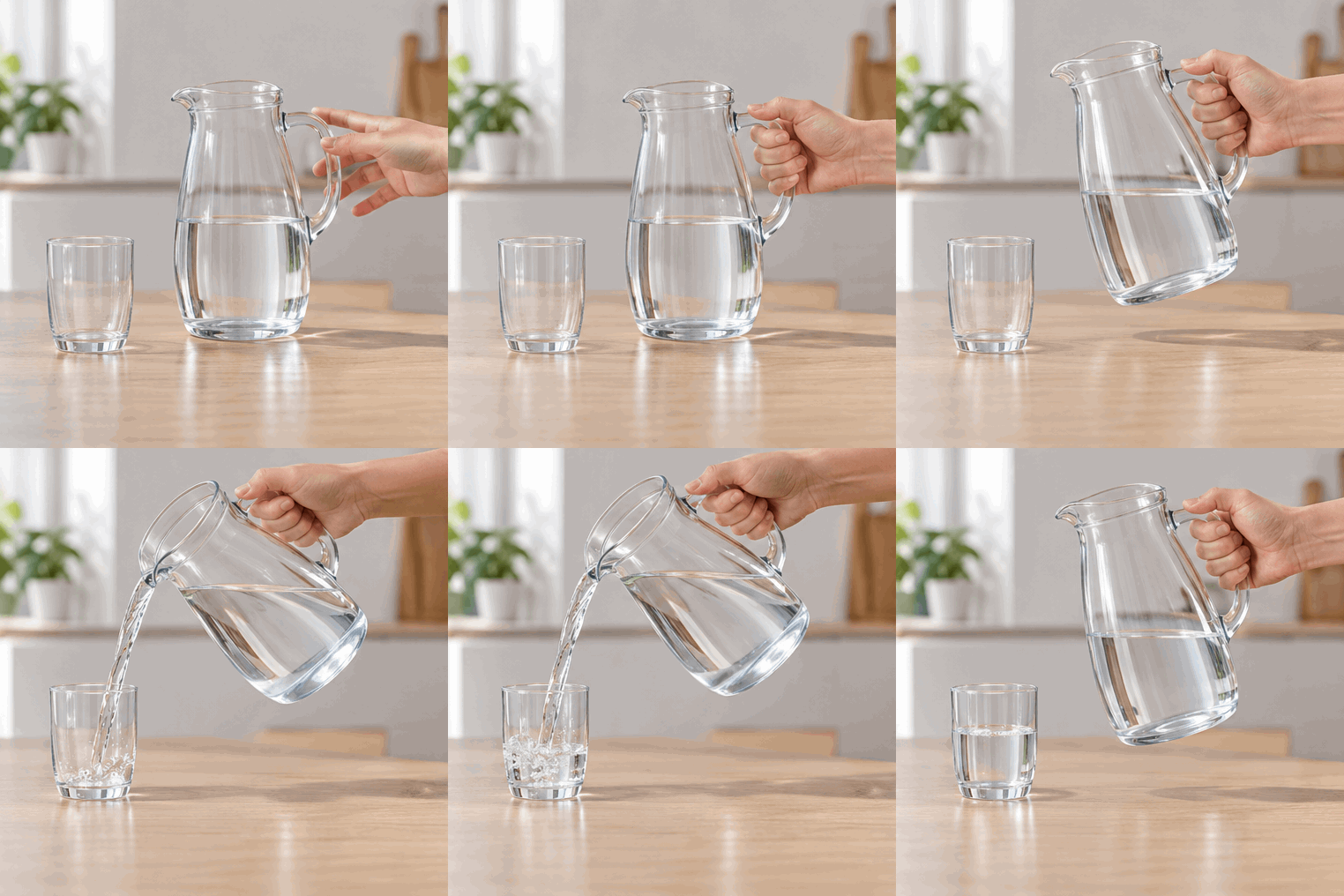
Here is an example of how Noesis learns to pour water from a jug.

Vision
A hand picks up a glass jug, tilts it, pours water into a cup and returns it upright
Text / audio
“The 3–5 second animation shows a hand picking up a glass jug, tilting it, pouring water into a cup, and returning it upright”
Memory stored
Fig. 01Lamp by AlexMotion Studio on IconScout

No weights are trained, and nothing already learnt is overwritten. Knowledge lives in a memory the robot can add to and check while it works.

What this means in practice

  • —One-shot learning. A single example is enough to learn something new. Our MVP learns objects in seconds.
  • —Continual learning. New memories are added alongside old ones, so the robot keeps learning after deployment.
  • —It knows what it doesn’t know. If nothing in memory is similar enough, Noesis abstains and says “I don’t know” instead of guessing.
  • —Small and efficient. One million objects fit in 50MB on a laptop, with no GPU.

Transformers remain the right tool for many problems, especially language and large-scale pattern learning in the cloud. Our view is that a robot working in a changing physical environment needs a different core: memory it can grow as it works, on the hardware it carries.

References

[1]Ashish Vaswani, Noam Shazeer, Niki Parmar, Jakob Uszkoreit, Llion Jones, Aidan N. Gomez, Łukasz Kaiser, Illia Polosukhin. “Attention Is All You Need.” Advances in Neural Information Processing Systems (NeurIPS), 2017.

Previous · October 2026 Noesis in simulation: 99% task success → Next · November 2026 Teaching a robot to pour: an LLM vs Noesis →

Teaching a robot to pour: an LLM vs Noesis

In our last post, we showed how Noesis learns to pour water from a jug, the way a child learns by watching and listening. This post follows the same task further: how a robot is taught to pour, how it learns, and how it carries out the pour.

We compare two approaches. The first is built around a large language model (LLM), sometimes paired with a separately trained robot control model (a policy). The second is Noesis.

01

Teaching

An LLM is taught through language. Noesis is shown the action as a look: what the finished pour looks and feels like through its senses. Then it is told its name.

LLM
Text steps
Video captions
Robot demos
↓
Stored asWeights: statistical patterns learned from text, and sometimes images.
Asked to do something untaught
Answers anyway (“grip the jug…”), drawing on text it has seen.
Noesis
LookJug in hand, the tilt, the stream reaching the rim.
Namelearn pour
↓
Stored asOne memory linking the goal, the look, the senses involved and the words. No weights are trained.
Asked to do something untaught
Abstains and reports the action as untaught until that look has been shown.
02

Learning

When an LLM learns, its weights change. When Noesis learns, a gap closes between what it senses and the look of a finished pour.

LLM
Gradient updates
The model learns to describe pouring.
↓Proof
Fluency, or a benchmark score.
Body
An optional control policy, built separately from the chat model.
Noesis
Match error
Within toleranceFar from the look
What it senses now is compared with the look until the two agree.
↓Proof
Tested against the look itself, with decoys and new setups.
↓
Combine with other skills
Run on a real body
Body
The same brain runs the body. If the robot lacks a wrist or gripper, Noesis refuses the task.
03

Execution

An LLM plans the pour in words and hands the steps to a separate controller. Noesis checks what it senses against the look at every step.

LLM
Plan the pour in language.
↓
Call a robot API, or replay a recipe.
↓
Steps run without checking the result, or a separate controller takes over.
When it fails
Hallucinated steps, or a policy that ignores real contact.
Noesis
See
→
Match the look
↑Every moment↓
Sense again
←
Move the joints
↓Goal matches
Stops and lowers its hands. Joints not involved hold still throughout.
When it fails
A missing sense or an unmatched look means rest and refuse, not an invented pouring recipe.
An LLM talks a pour, or runs a trained policy beside the talk. Noesis sees the pour, moves until what it senses matches, then rests. Teaching means showing and naming, not writing prompts or task-specific code.
Previous · November 2026 What is a transformer-less AI? Like a child learning →

Why is Noesis different

Most modern AI systems learn patterns and store what they learn inside a very large collection of numerical parameters. A Transformer, for example, learns to predict the next token by adjusting billions of floating-point weights during training. Those weights effectively become a compressed representation of the statistical patterns found in its training data.

This approach is remarkably powerful. But when we move AI out of the cloud and into the physical world, a different set of challenges emerges. A physical AI system needs to remember what it has experienced, learn from new situations, operate with limited compute, and recognize when it doesn't have enough information to act confidently.

This is where we believe Hyperdimensional Computing (HDC) becomes particularly interesting.

At a high level, HDC represents information using very large mathematical vectors called hypervectors. Unlike conventional representations that may rely on relatively small collections of numbers, hypervectors can contain thousands of dimensions. Information can then be represented and manipulated through operations such as binding, superposition, and similarity measurement.

What we find particularly interesting is that these operations can represent relationships and concepts without requiring the same kind of large-scale numerical computation used by many modern neural networks. A robot operating in the real-world encounters situations that its developers cannot completely anticipate. Objects change. Environments change. Sensors are noisy. New situations appear.

For these systems, continual learning and memory are not optional conveniences. They can become fundamental capabilities. We believe AI architectures for physical machines should therefore explore more explicit ways of representing and learning from experience, rather than relying entirely on knowledge compressed into model parameters.

This is the direction behind Noesis, our exploration of a new approach to Physical AI. To describe the architecture underlying Noesis, we use Hyperdimensional Cognitive Engine. The name reflects the idea behind our approach: combining the representational capabilities of hyperdimensional computing with an architecture designed around learning, memory, and decision-making for physical systems.

Next · July 2026 Noesis – The robotics intelligence stack →